Monday, March 27, 2017

On the Latest Iteration of Kong

On a clear day in New York City, some time in the early 1930s, Merian C. Cooper was walking through Manhattan and happened to glance up at the Empire State (then the tallest building in the world) as a warplane passed overhead. At this moment, a novel image crystallized in his imagination: a giant gorilla atop the building, swatting biplanes from the sky.

He couldn't have known in that instant just how many giant gorilla movies would spawn from this one epiphany. Cooper's 1933 King Kong was the classic that started it all, followed by Son of Kong (1933), Mighty Joe Young (1949), a string of Asian films in the 1960s and 70s including a Toho version of Kong as well as even more bizarre offerings like Konga (1961) and The Mighty Peking Man (1977), and more. These are only a few of the many, many films based on the concept of a gargantuan ape toppling trees and buildings and defying military might with his formidable monkey flesh. Oh, and there's usually a tiny blonde in there, trembling in the shadow of the monster's giant palm.


What exactly is the appeal? One might say that a gorilla as a pop icon is a projection of hyper-masculinity––the rife body-hair, bulging muscles, etc. This would explain the unfortunate pervasiveness of the quivering damsel trope in so many of these films. However, I believe there's more to it than that. Merian C. Cooper got his inspiration from the memoirs of French zoologist Paul Du Chaillu, arguably the man who first brought knowledge of the gorilla out of Africa to Europe. One imagines what Du Chaillu's first encounter with these imposing beasts must have been like. Gorillas share something like 98% of our DNA. If you'd never seen one before, you might well think you had happened upon some sort of half-man. And considering adult males weigh as much as 400 pounds, you might well be terrified. But gorillas aren't really as brutish as they're made to appear in pop culture. They're massive and dangerous, yes, but also gentle, family-oriented, and shy.

Not interested in climbing any skyscrapers, bruh

Therein, I think, lies the rub. Gorillas look like hairy pro-wrestlers but they're more interested in munching on bamboo than they are in body-slamming something. To observe one is to experience a sort of potential energy for monster behavior. The giant gorilla movie, then, is the realization of that primal fantasy.

The question is, if you flesh out that fantasy, does it make for good cinema? And if so, what's the trick to getting it right? The original 1933 Kong is an undeniable masterpiece, marred as it is through a modern lens by its hammy acting and sexism. It imbues Kong and his island with an abundance of mystery and finds the sweet spot between Kong's beastliness and anthropomorphism. And its ape-on-dinosaur mayhem is brilliantly choreographed for maximum visceral effect. I loved it when I was a kid. It was, for me, what the tales of Paul Du Chaillu were for Merian C. Cooper, Kong's creator.
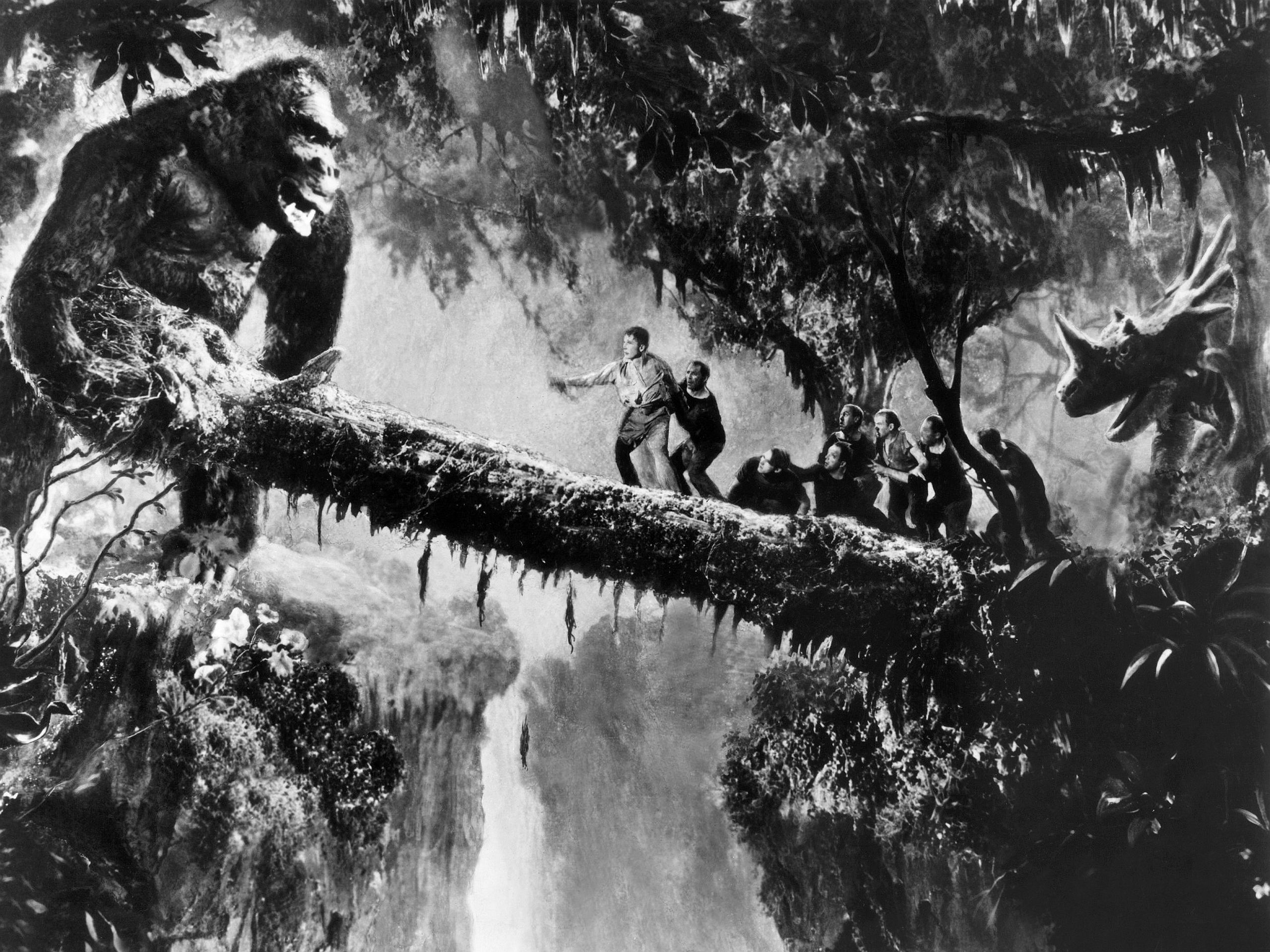
Seriously evocative

The 1976 Kong remake from Dino de Laurentiis is basically unwatchable. As in, I tried to watch it and just didn't make it. The human characters are unbelievably boring, except for the damsel in distress Dwan (that's right––Dwan) who is only interesting because she is so objectified by the script and the direction that she comes off as thoroughly bizarre. No human woman behaves like she's made to. And the action sequences are all just kind of meh.

Seriously uncomfortable

Peter Jackson's 2005 remake is a loving homage to the original, complete with action sequences that are beat-for-beat lifts from the 1933 version. I know some people who consider this film unwatchable as well, as it's 187 minutes long, Kong doesn't even appear in the first hour, and Jackson is pretty self-indulgent in all aspects of the production. But you can't deny the breadth of its scope, nor the depth of its themes. It contains Heart of Darkness references, clever homages to the original, a foil for Kong manifest in a writer living in a cage, a plausible geological explanation behind its island gigantism, and a masterful mirrored shot in which Kong is symbolically sacrificed to western civilization while an actress is faux-sacrificed to him. Jackson's Kong revels almost too much in its own mystery and majesty. It's an overlong, sprawling masterpiece and I love it dearly.

Seriously poetic

Which brings us to 2017. Legendary pictures have rebooted the Kong franchise as part of their cinematic Monsterverse which means that Kong now inhabits the same world as Gareth Edwards' 2014 Godzilla and will face off against said giant lizard in 2020. Speaking of Edwards' film, it takes a similar approach to Jackson's Kong in that it's a very slow burn and takes a while to show its monster, but it works because it attempts to make every shot of Godzilla meaningful by showing him exclusively from the POV of the tiny humans struggling to stay out of his way. The human story of that film is pretty boring, but when Godzilla is even partly on camera, he captures one's sense of wonder firmly in his reptilian grip.

Apparently, Legendary heard fans didn't like the less-is-more approach and have done a complete 180 with Kong: Skull Island. In this year's update of Kong, the eponymous gorilla is revealed in the film's first five minutes, and the pace of the movie is fleet and brisk. Action sequences are plentiful nigh unto gratuitous. I might go so far as to say the film abandons any sense of mystery, but what it lacks in suspense it makes up for in unabashedly over-the-top monster mayhem. This is the John Woo MI:2 of the Kong franchise. It also features the tallest Kong ever put onscreen (if you don't count the Japanese version of the character in his old Godzilla face-offs). This is a Kong who uses trees like baseball bats and ship anchors like brass knuckles. In several shots he's portrayed as a hulking silhouette against an impossibly huge, glowering sunset. In others, his eyes smoulder through the blooming fires of exploding helicopters. Good ole Samuel L. Jackson (who I can't really take seriously anymore) is often shown glaring defiantly at Kong when he really ought to be trying not to get squished by huge monkey feet or falling helicopter debris. And don't get me started on the ridiculousness of a certain character's gas mask/katana spree.

No similarities here

I don't mean to knock it; it's a fun movie. I was just a bit surprised by the cheese factor. There are quite a few human characters and not enough of them have arcs, but the 1970s setting is refreshing and the performances are good. John C. Reilly, in particular, is a big highlight. A lot of people will enjoy this movie as action-packed, low-maintenance escapism.

But I'm honestly not here to talk about the film per se so much as its portrayal of Kong as a pop culture icon. And there are a couple interesting things about his depiction here.

Firstly, his look is a big step away from Peter Jackson's overgrown silverback and a big step in the direction of his classic monster roots. He's bipedal. His eyes are buggy. His sagittal crest is reduced and his brow exaggerated. The director Jordan Vogt-Roberts has said, "We worked really hard to take some of the elements of the ’33 version, some of those exaggerated features, some of those cartoonish and iconic qualities, and then make them their own."

The second thing that interests me is his relationship to humans. In previous versions, Kong was separated from the tiny, hairless apes on his island by an ancient, impenetrable wall. He was placated with sacrifices and, once through the wall, happily stomped and munched on anyone in his path. In this film, he's less of a monster and more of a benevolent god to the natives and has no interest in devouring maidens or smashing villages. His one goal in life is to keep the subterranean skull-crawlers subdued and as long as he's keeping up on his goal, he's happy. "Keeps to himself mostly," says John C. Reilly's character.

Thirdly, Kong is poised for interaction with other monsters in Legendary's new Monsterverse. The tone of Kong: Skull Island is so different from that of Godzilla that it will be fascinating to see how they combine in 2020. In this film, Kong stands 104 ft. tall but is reportedly only an adolescent and will have grown substantially by the time he meets the radioactive lizard in a modern setting. That's good because Gareth Edwards' Godzilla stands at 350 ft. and it wouldn't be much of a contest if the current stats remained unchanged.

And, last of all, let's all be happy that Kong no longer comes with a half-dressed supermodel to tote around. Peter Jackson did his best to make Ann Darrow more of a volitional character and less of a prop, but in Skull Island the closest thing we get to the damsel in distress is Brie Larson's character who needs saving for about thirty seconds tops, doesn't really scream if I recall, and also gets to shoot guns and stuff. I, for one, am happy that we can kiss that aspect of the Kong icon goodbye. Kong: Skull Island earned a 78% on Rotten Tomatoes and it did that without needing a damsel in distress. And so the giant ape continues to evolve.

Sunday, March 20, 2016

Fires, Hymns, and Organists: Recollections of the Provo Tabernacle

It was roughly 3 in the morning when my cousin Steve shook me awake. Rubbing the sleep from my eyes, it took me a moment to remember that I had fallen asleep on my other cousin Patrick's couch while the three of us had been hanging out.

"Mike, wake up," said Steve. "The tabernacle is on fire."

"...what?"

Life is weird at 3 in the morning. Things that are not so seem so and vice versa. Things get especially surreal if you've already been asleep for a while and are awakened by the news of something being on fire. So it was with me. A few minutes later, the three of us were standing in downtown Provo in the cold December blackness, witnessing the event from a safe distance.

There stood the old tabernacle. Flames peeked out of broken windows and a great black plume spilled upwards from the roof. We watched the inferno for a while until the cold and grogginess became too much for me and I went home to bed. Steve and Patrick, however, were still watching when the roof collapsed and later described it to me.

In the weeks that followed, when I would drive by the charred husk of that old building, I reflected on the few experiences I had there. Like many BYU students, I'd participated in a stake conference or two within those walls. One conference in particular stands out as one of my fondest memories.

I had been called as a stake choir director in my singles stake. I'd taken a course on choral conducting at the Y and so I knew a little more about conducting than what you find in the front of the hymn book. It was fun to put those skills to use as I helped prepare the choir to sing "The Spirit of God Like a Fire is Burning."

During one rehearsal at the Manavu Chapel, after drilling parts and pinning down the breaths and dynamics, I gave a mini lesson on the background of this particular hymn in an attempt to make the experience of singing it more personal for everyone. Most members of the church know that "The Spirit of God" was sung at the dedication of the Kirtland Temple in 1836. During the Kirtland period, many of the saints were hounded by mobs in Jackson County and Clay County Missouri, suffering eviction from their homes, destruction of property, and violence. In Joseph Smith's dedicatory prayer, he pleaded with the Lord:

"We ask thee, Holy Father, to remember those who have been driven by the inhabitants of Jackson county, Missouri, from the lands of their inheritance, and break off, O Lord, this yoke of affliction that has been put upon them. Thou knowest, O Lord, that they have been greatly oppressed and afflicted by wicked men; and our hearts flow out with sorrow because of their grievous burdens."
(D&C 109:47-48)

In the midst of these hard times, there was also a great outpouring of spiritual manifestations and miracles. During the dedication, some in attendance reported the rushing of a mighty wind like on the day of Pentecost, and others were reported to have spoken in tongues.

"Angels appeared to some, while a sense of divine presence was realized by all present, and each heart was filled with 'joy inexpressible and full of glory.'"
-Eliza R Snow

My point in sharing this with the choir was that, to me, "The Spirit of God" is an encapsulation of that circumstance: hope in the midst of turmoil. That even when wolves are after you and the way seems hopelessly bleak, the gospel engenders the hope of a brighter day.

The Spirit of God like a fire is burning;
The latter day glory begins to come forth;
The visions and blessings of old are returning;
And angels are coming to visit the earth.
We'll sing and we'll shout with the armies of heaven:
Hosanna, hosanna to God and the Lamb!

Before this mini lesson, the choir had been starting to sound pretty good as we buckled down on the technical aspect of things. After the mini history lesson, however, I asked them to sing again. And this time, as they focused on the meaning of the words, I was nearly blown backward through the chapel walls. It was as if the choir had doubled in size or had been joined by unseen angelic recruits. Truly inspiring.

A week or two later, we were in the tabernacle on the day of the conference. The choir sounded great. We had been instructed that I was to bring the congregation in on the last verse, as is traditional. When I turned around to face the congregation, there was a whole stake of singles singing at me. The panorama of that stately building was a sight to see. I'll never forget it.

Let's fast forward several years to a few weeks ago when Nicole and I volunteered to help with the City Center Temple open house. Like everyone else, I was excited to see what had been done to turn the shell of the old burned-out tabernacle to make it into a temple. I was on wheelchair duty which mostly meant waiting by the entrance, covering the wheels of other people's wheelchairs with plastic. Lucky for me, it also meant pushing people in wheelchairs through the temple tour if there was no one to assist them. A few minutes into my shift, I had the opportunity to push an elderly gentleman through the tour. He didn't say much. In fact, I don't recall him speaking at all, but the two ladies with him (his wife and daughter) informed me that this was, in fact, Parley Belnap, a retired professor of organ and music theory at BYU. This man had trained in Paris and Belgium, been the organist for the BYU Jerusalem Center, and had played countless recitals on the organ in the old Provo Tabernacle.  I had heard his name before because, when I was working for Tantara Records at BYU, an album of his organ playing was in our inventory. His wife and daughter were delighted that I'd heard of him and further delighted to hear that I'd been in the School of Music at BYU. I took care to give his wheelchair the best vantage points I could along the tour, knowing this place held many more memories for him than I.

At the end of the tour, they included me in the family picture and emailed it to me.

Much has been and will be said about the beautiful symbolism inherent in the tabernacle's transformation and rebirth. But the most poignant part of my experience with it is that it gave me the chance to push Parley Belnap through that beautiful building. I don't know what exact ailments incident to age or illness had him wheelchair bound and hardly speaking and I don't even know how lucid he was. But his very presence inspired a reverence in me. The places that old man had been, the many accomplishments he had to his name, all fading in the dim light of old age, becoming history. We'll all go that way eventually. But the thing I remember most about the tabernacle are the words,

How blessed the day when the lamb and the lion
Shall lie down together without any ire
And Ephraim be crown'd with his blessing in Zion,
As Jesus descends with his chariots of fire!

We're all going the way of the tabernacle, but we're going together. And one day, we'll all be one beautiful temple: Zion.

Wednesday, February 10, 2016

Hail, Caesar! Movie Review

About a month ago, Jennifer Lawrence was in the news for being rather rude to a reporter during a press conference at the Golden Globes. Across the nation, many young hearts sank at the thought that this down-to-earth, relatable movie star (usually so cheerful and winsome) could be so callous. The story circulated on social media, then came the follow-up opinion pieces about how her words and tone were justified based on new information. Regardless of what we ought to think of this story, it's clear that we as a culture care a great deal about what movie stars do and who they are.

And that is the question at the heart of the latest release from the Coen Brothers. Who are the people behind the movies we love? Does it matter what kind of people they are? Hail, Caesar! is a love letter to classic Hollywood that paints a studied contrast between the emotional uplift of movie magic and the flawed mortals that create it.

The first thing you should know about this movie, if you've seen the trailer, is that the marketing is a bit misleading. Rather than a slick, fast-paced farce, Hail, Caesar! is a thoughtfully understated comedy. That's definitely not a bad thing, but I had to really shift gears after the film started to adjust to the more ponderous tone.

Josh Brolin plays Eddie Mannix, a movie producer overseeing a wide tableau of films at Capitol Pictures in the 1950s. In addition to managing the shootouts, dance numbers, and grandiose sets of the studio, Mannix must also juggle the indiscretions of his stars, making bad press go away. As he moves between buildings at the studio, we're treated to a series of delightful vignettes showcasing the old Hollywood genres. Scarlett Johansson executes adorable princess-waves amidst a bevy of synchronized swimmers, Channing Tatum proves he can dance and sing while looking handsome, and George Clooney delivers epic monologues on the dusty roads of ancient Rome. The titular Hail, Caesar! is Capitol's most prestigious release and it evokes Ben Hur in more ways than one. In the midst of all the fixing Mannix is already doing, his duties are further complicated when Clooney's character is kidnapped by some mysterious men calling themselves The Future.

But the story's not really about that, contrary to what the trailer would have you believe. It's more of a slice-of-life, behind-the-scenes look at a romanticized old Hollywood. Various subplots from Mannix's personal life and the lives of the stars are given just as much weight as the kidnapping. My favorite scene involved a high brow director (Ralph Fiennes) struggling to make a thespian of a cowboy. I also particularly enjoyed a subplot about a pair of rival gossip columnists, each one thinking she is above the petty sensationalism of the other.

All the actors here, and the Coen Brothers themselves, are clearly having the time of their lives. The film is thoughtfully acted and beautifully shot. The artful lighting and gorgeous color are a breath of fresh air amidst the grain and dull teal of 2016 cinema.

The one aspect of the film that perhaps brings it down a little is a lack of consistency in tone. I highly recommend reading this fascinating memo from The Brady Bunch's Robert Reed on the different genres of comedy and why mixing them can be problematic. I think Hail, Caesar! suffers from a bit of that. Some jokes are a little too out of place to really hit hard. But it's a small complaint, and one I can probably blame on the misleading marketing anyway.

One last tidbit about the film: I was pleasantly surprised by how religious it was. Most Hollywood blockbusters feel benignly atheistic to me, as if the studios are either made up mostly of atheists or they're afraid they'll alienate their target demographics if religion slips into their scripts. Hail, Caesar!, however, feels refreshingly sincere in its approach to its religious elements, none of which feel pedantic or forced.

In the high points of the movie, we really feel the fervor of a great cinematic speech, we find ourselves grinning as talented whippersnappers tap dance across the screen. These moments, scattered across thousands of films, are truly uplifting, even if the lives of the films' creators leave some integrity to be desired. They're not perfect. Neither are we. Let's keep going to the movies anyway.

The trailer for Hail, Caesar! was a lot of fun and I confess I'm a little disappointed I didn't get to see the movie it advertised. The film itself, nevertheless, is a wonderful piece of mirth and sincerity and I highly recommend it.

Rated PG-13: Some language, some suggestive thematic elements, lots of smoking.

Wednesday, February 3, 2016

Aloha: Movie Review

Disclaimer: the following review contains spoilers because no one's enjoyment of this film is at risk if I spoil anything. It's that bad.

So here's the thing: I'm sick today. My body is achy and lethargic, and the icy grip of winter isn't doing much to improve my spirits. So I decided to watch a film that I had heard wasn't very good (but that is set in Hawaii and has a lot of healthy-looking, smiling actors) to transport me to a land of warm beaches and swaying palm trees. Sure, it's not supposed to be that great. But I could use some simple-minded escapism.

Such were my expectations going into Aloha. Breezy, dumb, tropical romantic comedy. What I got was a bizarre sci-fi fantasy family drama that includes an apparition of ancient spirits, the Hawaiian version of the Force, and a climax that happens in space with the most ridiculous bit of "science" mumbo jumbo I've ever seen. What I just wrote makes it sound kinda cool, but rest assured, most of this movie is just people standing around saying awkward things to each other in a manner that in no way resembles actual human conversation. And while there are palm trees and some Hawaiian people, surprisingly few scenes are shot outside. There are more shots of satellites than there are of beaches. According to director Cameron Crowe, Aloha is meant to be "a love letter to Hawaii." Pretty sad that most of the film feels like it could have been shot in Colorado.

Bradley Cooper plays Brian Gilcrest, an ex-military man who was wounded in Afghanistan and now helps private defense contractors with...stuff. It's a little unclear what his skill set or job description is supposed to be. Anyway, he returns to his old Air Force base in Hawaii to help sleazy billionaire Carson Welch (Bill Murray) put a satellite in orbit and get the blessing of the natives for a gate of some kind. Upon arriving, he reunites with his old flame Tracy (Rachel McAdams) who's married and has kids with John Krasinski. He's also assigned an Air Force handler Captain Ng (Emma Stone), a spunky, blonde, Irish-looking quarter Hawaiian who spends five minutes as a no-nonsense career woman until she morphs into a manic pixie dream girl. Much has been said elsewhere about this strange casting choice, but this is far from the film's only problem. And without Stone's unbeatable likability, I don't think this thing would have been remotely watchable anyway.

Many movies that I see struggle from not knowing what kind of film they want to be, or not knowing what the central conflict is. Aloha, by contrast, is entirely composed of random changes of tone and direction. Scenes between Cooper and Stone move from gruff and abrupt ("don't try to pick my brains; they're unpickable") to cutesy flirting ("they're like Hawaiian leprechauns," "or chipmunks" blush, giggle, giggle, blush), to shouting at each other ("she gave me the heave, okay!") in a matter of seconds.

One character is a stoic man of few words in one scene, then in the next he is completely silent and the film goes for a gag about how men communicate with looks and nods, then in the next scene he's as talkative as any other man, then he bashes the head off a lawn ornament in rage. Later they bring back the silent conversation gag with subtitles, but in a film that takes itself this seriously and seems to be going for realism the rest of the time, it feels extremely out of place.

There's an uncomfortable dance sequence between Emma Stone and Bill Murray. There's a little boy who is convinced Bradley Cooper is the fulfillment of an ancient Hawaiian prophecy called The Arrival. There's a climactic sequence where Bradley Cooper destroys a satellite by "pinging" it with all recorded sound in earth's history.

The effect of all this is that the movie feels like a self-indulgent, rich director's patchwork pet project. "I'd love to make a movie about Hawaii's spiritual displacement in 21st century America, also about how veterans cope with traumatic combat experiences affecting their family life. Also, space is cool. I'd love to make a movie about space. How about a story about the ethics of putting weapons into orbit? Also, I'd love to make a movie about moving on from old relationships, or discovering you've had a daughter for the past thirteen years, or rekindling one's passion and wonder after life's hard realities have made you cynical." I could go on. Aloha can't settle on a plot.

Writing this review, I'm struggling not to slip into the stiff, heightened language employed by the characters in this film. No one speaks or acts like they do. And these actors are all really good in other roles, so once again I think that tips the hand of the director just being out of touch with reality. Some of the cinematography is pretty darn good, but I could sense the presence of a second unit cinematographer who couldn't help overexposing outdoor scenes.

Anyway, that was all pretty harsh, and perhaps I was harder on this movie because I'm not feeling well. But should you find yourself under the weather, and you want some tropical, light-hearted escapism, I'd recommend looking elsewhere for it.

Thursday, August 20, 2015

Gigs

I've played a lot of gigs over the years. As a musician, the great challenge of my life is to make a living--to find the projects that are most lucrative and, frankly, performing doesn't make that list. Some cats make a lot of money gigging out; I'm not one of them. For me, however, gigs are their own reward. I live for them. They remind me of the magic that I need to capture in all my studio projects--the magic of artist and listener sharing a moment. So, while there's not much money in it, I've tried to keep playing as much as I can. And I hope that as I get older I'll always have someone to play with and somewhere to play. Some gigs are amazing. Some aren't. Some are downright bizarre. And sometimes, as the years go by, I forget the unique and weird circumstances around bygone shows. I've been thinking back, lately, through the old mental scrapbook and I wanted to take this opportunity to jot down some random gigs that I remember. I chose to mention these, not necessarily because they're my favorites, but simply because they make me say to myself, "Yeah, that happened."

Note: The following examples include experiences with various bands, ranging from Provo-based rock bands to university performing groups to solo work.

Here we go...

I once played the Confetti Antiques and Books release party for one of the Twilight books. Attendees were mostly pre-teen girls and middle-aged women. And the band was in black tie for some reason.

I once sang the Red Hot Chili Peppers' "Can't Stop" to a basketball arena full of screaming freshmen at BYU's new student orientation. No one in the audience or band knew what that song is about. Still don't.

I played an ABBA medley in Stockholm to such thunderous cheering and applause you'd have thought we were ABBA in the flesh.

I once improvised a song for a live audience in the middle of a pop/rock set. The lyrics described the story of an audience member who ran over a sheep on the way to seminary. I'm never doing that again.

My good friend and I won a songwriting competition and I played our winning entry at a replica pioneer village. My self-confidence was so bolstered that night that I actually successfully flirted with my crush. Yep. Victory.

I once sang at a prison.

Lindsey Stirling opened for my band once.

At a competition, my band once beat Imagine Dragons.

I once played a rock song for a stadium full of people and got booed by the country fans in the front who were there to see Brad Paisley. Also, I got my picture taken with Brad Paisley.

I played "Fire" by Jimi Hendrix with a one-gig band that included Robbie Connolly of Fictionist. He and I screamed into the same mic. For me, that's like saying I played Basketball with LeBron James. I did not deserve to be on that stage that night, but I have never been so possessed by the spirit of rock and roll.

I once sang "Billie Jean" at a Mother's Day event at Deseret Book across the street from Temple Square, with the temple in full view. I felt so awkward about singing those lyrics in that setting that I changed the words to "Billie Jean is not my mother." Yeah, it made no sense.

I played my wife a love song I wrote for her at our wedding reception, thereby technically making our wedding reception a gig. Best. Gig. Ever.


Sunday, October 19, 2014

They're Selling You Fake News...And You're Buying It

Stop.  Before you read any further, look at the top of the page.  What website did you just navigate to?  You should find something that has blogspot.com somewhere in there.  Do you see it?  Good.  That's very, very important.  Now keep reading.

When I was in high school, the internet was still pretty new.  So new, in fact, that many of my teachers, when giving us research assignments, instructed us not to use the internet at all because the internet on the whole was not a reliable source of information.  

By the time I graduated from college that had all changed.  These days, finding reputable information online is just as viable as finding it in a book in the library.  Care was taken, of course, by my college professors to point out that not all online sources are created equal and that a science journal is different from a Wikipedia article.

Now, it seems, many of my facebook friends have completely forgotten this lesson as it applies to our daily intake of information.  As you scroll through your news feed on any given day, you are likely to come across all sorts of headlines.  You click on them, navigate to a web page...  What is the first thing you do?  Do you look at the web address?  No, neither do I.  Most of us just aren't in the habit of doing that and we're far more interested in whatever it is we're about to read than who wrote it.

And that's a problem.

On any given day, there is a high probability that some of the "news" you encounter is utterly fake.  Now, I'm not talking about news in general ("the liberal media is lying to us!").  I'm talking about websites that create deliberately false headlines for satirical purposes.  If you didn't already know about them, it's important that you do.  So, Here are a few examples of headlines I've come across that were shared with me by individuals who were convinced this was actual news:

I discovered this article in my facebook feed when it was shared by some very smart, liberal friends.  They were ecstatic that the Pope was making such radical statements as: "We must recognize that religious truth evolves and changes. Truth is not absolute or set in stone."  "The church no longer believes in a literal hell where people suffer."  "All religions are true, because they are true in the hearts of all those who believe them."  "In the past, the church has been harsh on those it deemed morally wrong or sinful. Today, we no longer judge."  The problem?  The Pope never said any of that.  And the Third Vatican Council never happened.  Fake news website.

The abstract:  "A team of psychologists and medical doctors associated with the Technische Universität of Berlin, have announced this morning that they had proven by clinical experimentation, the existence of some form of life after death.  This astonishing announcement is based on the conclusions of a study using a new type of medically supervised near-death experiences, that allow patients to be clinically dead for almost 20 minutes before being brought back to life."
I heard about this one through word-of-mouth from someone I very much respect and whose opinion I value.  When I heard about it, though, I thought:  "If that's true then that's a really big deal.  Let's investigate."  I found the article...and found the disclaimer.  Fake news website.

Capitalizing on our worst fears of a terrible disease becoming airborne and preying on innocent families, this article tells the story of an Everyman returning from Dallas and infecting his family with Ebola despite having no contact with real-life Ebola patient Thomas Eric Duncan. The thing is, it didn't happen, though the article was shared tens of thousands of times on facebook within a few hours, according to Snopes.

My guess is that while reading those headlines you may have thought they sounded hokey to begin with.  Who would ever believe that?  Well, in the context of this blog post, after my having told you they were going to be fake, of course they sound phony.  But in the context of a facebook feed, surrounded by dozens of legitimate news headlines, people are easily hooked and they forget to look at whether this is coming from CNN or from some jokester.  

"Who is responsible for content like this?" you may ask.  If you're online a lot, you're probably familiar with some satire sites like theonion.com.  I love the Onion.  And while some people still take their headlines literally, (some examples, language warning) most of the time, it's pretty obvious this stuff isn't legitimate news (Man Surrounded By Loved Ones Feels Awkward Being Only Person Dying).  Other fake news websites are not so transparent in their presentation and create headlines we're willing and ready to believe.

Here's the disclaimer from a website called the Diversity Chronicle.  Actually, the web address is http://diversitychronicle.wordpress.com.  Lesson learned.


"The original content on this blog is largely satirical.

'I ceased in the year 1764 to believe that one can convince one’s opponents with arguments printed in books. It is not to do that, therefore, that I have taken up my pen, but merely so as to annoy them, and to bestow strength and courage on those on our own side, and to make it known to the others that they have not convinced us.' – Georg Christoph Lichtenberg.

It is in the spirit of the above quote that I write. Who am I you may ask? My name is Erik Thorson. I created this blog for my own personal amusement."


So there you go.  It's called satire and it is meant to hold human follies and vices up to ridicule whether through humor, sarcasm, or even willful deception.  And here's the thing: By buying into these fake headlines, we prove their point and illustrate some of the flaws in human nature that these satirists are out to ridicule.  We prove our gullibility and our thirst for sensationalism.  But the important point here is that, if you consume content on the web, you should know that there are content creators out there whose content is simply bogus.  The internet "does not have a 'truth' filter." -Neil L. Andersen  So, before you believe the next thing you read, stop.  Look at the top of the page.  See where you are?  Good.  Make that a habit.

P.S.
To help you out, here is a link to a list of websites creating fake news content.  This list will soon be outdated so just stay skeptical, friends.

Sunday, September 7, 2014

A Mormon Word We Don't Use Enough

Words are cool.  Also, being a Mormon is cool.  Therefore, Mormon words are also cool.  And by Mormon words, I think you know what I mean.  Part of being a peculiar people is using peculiar language, and I'm not just talking about the specific vocabulary of gospel or church-related ideas like RM or Zarahemla.  I'm talking about when there's an extra roll of toilet paper under the sink hidden behind some Clorox and you say to yourself, "Tender mercy."  Other examples include the word "contention," the phrase "ox in the mire," or when I used the phrase "peculiar people" a few sentences ago.  Recently I saw a Utah-made sci fi film in which a futuristic alien said, "Will you not put down your weapons of war?" which is a hebrewism found in the Old Testament and Book of Mormon not unlike "river of water" or "flame of fire."  My point is, just as English speakers unconsciously borrow a good deal of their speech from Shakespeare, Mormon vocabulary is full of scriptural and cultural words that are peculiar to us.

I'd like to discuss one of my favorite scriptural words, one that I think doesn't get used nearly enough, and suggest that we all use it more.  Here it is:

Edify:
To instruct or benefit, especially morally or spiritually; uplift.
Origin: 1300–50; Middle English edifien  < Anglo-French, Old French edifier  < Latin aedificāre  to build, as in a house or temple (dictionary.reference.com/browse)

The word "edify" enters our religious lexicon in the New Testament, first in Acts 9:31:  "Then had the churches rest...and were edified."

The word appears to have the same function as the word "confirm," as used in multiple New Testament passages that describe Peter or Paul confirming the church.  In other words, to edify or confirm an individual or group is to build them up, to strengthen them, to leave them uplifted.  To edify is to build the kingdom.

The kingdom in New Testament times sure needed edifying.  As Paul would sail from Mediterranean Islands to European shores, he would enter a congregation of saints and find them in turmoil.  In his absence, a blog post about modesty would have circulated that called into question church authorities' views on the matter, followed by a rebuttal from Jessica Rey fans, and a mass sharing of a Matt Walsh piece.  A few weeks later, it would be women and the priesthood, or the legalization of same-sex marriage, or the authenticity of the Book of Abraham and the Corinthian Facebook feeds would all be ablaze in contention.

Okay, so it wasn't exactly like that.  But I think it is important to remember in our day of polarizing issues that a very large portion of the New Testament was written by apostles in response to disputes among church members.  As I read the writings of Paul, I get the image of a frustrated man who wishes the house would just stay clean for two seconds and not unravel into apostasy every time he turned his back.  Whether it was church members clinging to the law of Moses, fighting over whether to continue circumcision, confusion over the purpose and correct use of the gift of tongues, or faction-forming within the Church, Paul's constant song was edification and unity.  (See also 1 Cor 14:3 and 1 Tim 1:4). 

Consider his thoughts on the purpose of a priesthood organization in the Church:  

"And he (Christ) gave some, apostles; and some, prophets; and some, evangelists; and some, pastors and teachers; For the perfecting of the saints, for the work of the ministry, for the edifying of the body of Christ: Till we all come in the unity of the faith, and of the knowledge of the Son of God, unto a perfect man, unto the measure of the stature of the fulness of Christ: That we henceforth be no more children, tossed to and fro, and carried about with every wind of doctrine, by the sleight of men, and cunning craftiness, whereby they lie in wait to deceive" (Ephesians 4:11-14)

The Lord deploys his spokesmen for the purpose of edification and unity.  In other words, The Lord would have us be one.  "If ye are not one, ye are not mine." (D&C 38:27). 

I've been noticing a trend among some friends whose thoughts populate my social media feeds.  There are those who like to stir the pot sometimes, to play devil's advocate, to criticize church policy, or to bring up historical or doctrinal inconsistencies or difficulties with the declared intention of inspiring deeper thought, more informed conviction, and a more open discussion about the skeletons in our collective religious closet.  I would caution us all to be wary of such waters.

I am all for a greater understanding of church history and doctrine and I fully support a more open dialogue.  In my experience, however, what is often done in the name of reevaluation of thought and opening dialogue may sometimes be motivated more by personal gratification -- the need to feel smarter, more enlightened than the rest, or possibly the need to justify one's unorthodox behavior.  I say this because I've felt this motivation within myself when I've caught myself preaching the gospel of Mike and it has disguised itself thus.  I believe we should treat this motive cautiously.  As Paul says once again, "Let all things be done unto edifying." (1 Corinthians 14:26)

When I was in high school, I had a friend who was like a Nephi to me.  We'll call him Ryan.  He was a man large in stature (see what I did there?), popular yet humble, and an impeachable example of a young Latter-day Saint.  Among my group of friends, we would half-jokingly refer to him as our moral compass, which would frustrate him, but he was a good sport about it.

One day, between classes, Ryan and I were walking with a non-member friend who we'll call Chad who was trying to needle Ryan about his conservative values.  Chad justified his teasing with words to effect of, "I'm just trying to get people to think, you know?  That's how people figure out what they really believe."

Ryan would not be fooled.  "No, Chad, that's how you ruin people's lives."

That response may strike you as dramatic.  It was.  It stuck with me for years and years and kept me from straying into some controversial ground before I was ready for it.  Once again, don't misunderstand me.  Knowledge is power and I am all for people learning everything they can.  I just believe knowledge is meant for strengthening people, not weakening them.  I'm full of Paul quotes today.  Here's another one:  "Let us not therefore judge one another any more: but judge this rather, that no man put a stumblingblock or an occasion to fall in his brother’s way...  If thy brother be grieved with thy meat...destroy not him with thy meat."  (Romans 14:13,15)

So how important is this whole edify thing?  There's no real harm in being a little iconoclastic, right?  I can think of no response more direct than this:

"That which doth not edify is not of God, and is darkness." (D&C 50:23)

I am sure we would all rather not deal in darkness.

Let me suggest 3 filters we all use on ourselves as these polarizing issues come up to help us edify one another.  When interacting with others online or in person, ask yourself:

1) Does what I am saying uplift or put down those with whom I am communicating?

2) Does what I am saying make me feel superior to others, or equal with them?

3) Are we all happier/better for having had this discussion?

If we truly wish to move forward, to inspire a more open dialogue, to better inform our beliefs and testimony, to eliminate damaging stigmas, to erase stereotypes, and above all to live more fully the gospel of Jesus Christ, we need to follow Paul's counsel.  "Let all things be done unto edifying." (1 Corinthians 14:26). If we can do that, we may find our way more quickly to the happy medium of polarizing issues.  We will find ourselves radiating a more Christian sense of compassion and joy.  We can pull some pockets of darkness in the world into a brighter light.